Introduction

The Master of Science in Climate Change aims to support the Cambodian Governments’ existing initiatives in climate charge adaptation and resilience by providing a strong capacity building opportunity for both the public and private sector in Cambodia. International students who want to learn from experts in the field in a groundbreaking degree in a developing country will be exposed to a professional learning environment in an academic department with a commitment to excellence.
The Master of Science in Climate Change is designed to develop human resources at the mid-level of government agencies who currently lack capacity for climate change adaptation, mitigation and development planning. In addition, the Master of Science in Climate Change will attract new science graduates, graduates from any discipline and qualified professionals who are currently working in fields related to climate science and climate change in the public and private sectors
Vision and Goals

The Master of Science in Climate Change aims to support the Cambodian Governments’ existing initiatives in climate charge adaptation and resilience by providing a strong capacity building opportunity for both the public and private sector in Cambodia. International students who want to learn from experts in the field in a groundbreaking degree in a developing country will be exposed to a professional learning environment in an academic department with a commitment to excellence.
The Master of Science in Climate Change is designed to develop human resources at the mid-level of government agencies who currently lack capacity for climate change adaptation, mitigation and development planning. In addition, the Master of Science in Climate Change will attract new science graduates, graduates from any discipline and qualified professionals who are currently working in fields related to climate science and climate change in the public and private sectors.
Admission

Admission to the Master of Science in Climate Change follows existing RUPP rules for postgraduate entry:
A bachelor degree or equivalent degree in natural or social sciences from a recognised University in the field of natural resource management, development studies, forestry, fisheries, agriculture, environment, geography, biology, mathematics, physics, computer science; or
A degree in any discipline from a recognised University
Potential students must pass an Entrance Examination
Potential students from a non-science background must successfully pass a three course Bridging Program prior to enrolment
Application Requirements
Application form (2) (one in Khmer and one in English for Cambodian applicants; one in English for foreign applicants)
A certified copy of Bachelor’s degree or an equivalent
A copy of bachelor transcript
Research Plan (completed with the application forms)
Recent 4 x 6 photos (3)
Recent 3 x 4 photos (2)
Application and Entrance Examination Fees: US$ 20.00 (non-refundable)
Entrance Examination
The entrance examination is organized to test knowledge of students in general basic science and their English proficiency. The test of general basic science lasts 120 minutes while English test (interview) takes 20 minutes.
Tuition Fee
The tuition fee for the entire program (24 months) is US$ 2,000 for Cambodians or US$ 4,000 for foreigners. This fee should be paid by US$ 500.00 or 1,000 installments at the beginning of each semester or by US$ 1,000 or 2,000 installments at the start of each academic year.
Class Schedule Available
| Week Day | Time | Weekend | Time |
|---|---|---|---|
| Monday-Friday | 8:00-20:00 | Saturday | 08:30-11:30 |
| Saturday | 08:30-11:30 14:00-17:00 | ||
| Sunday | 08:30-11:30 |
Academic Calendar
Registration Deadline: Feb/Oct 16
Examination Date: Feb/Oct 27
Class Start: Mar/Nov
Curriculum

Program Description
Master’s Degree will be the equivalent of 2 years (4 semesters) of full-time study or part-time equivalent (minimum 48 credit points, including course work and thesis). The program will be offered in a flexible delivery mode; that is in weekday and /or weekend or other intensive classes. Students who pass the final examination will qualify to complete a research report or a more detailed research thesis. The program comprises a core curriculum and a range of common courses, which are outlined in the following sections.
Curriculum Structure
The Master’s degree consists of minimum 48 credit points and is normally conducted over four semesters, that is, two years full-time or part-time equivalent. A course is generally three (3) contact hours per week over 15 weeks of teaching and is three (3) credit points. The examination period follows the end of the teaching period for each course.
The Master of Science in Climate Change curriculum will consist of:
The Master of Science in Climate Change curriculum will consist of:
A preparatory bridging program of three courses (9 credit points) specifically designed to support non-science graduates. Students must pass all the bridging courses to progress. Students can use successful completion of the bridging course as credit towards the Master’s degree.
A core curriculum of four (4) courses.
Major subjects of six (6) courses.
Eight (8) elective courses. The elective courses to be offered will vary from semester to semester depending upon the need of students and focus of the program.
Students who successfully pass the final examination can choose to enroll in a research thesis (up to 100 page limit).
| Courses Bridging (9 credits) | Code | Credits |
|---|---|---|
| General statistic for Climate Change (PRE-1) | BCC001 | 3(3-0) |
| Climate and Weather (PRE-2) | BCC002 | 3(3-0) |
| English for Climate Change (PRE-3) | BCC003 | 3(3-0) |
| Master Courses | ||
|---|---|---|
| Semester 1 (15 Credits) | Code | Credits |
| Basic Science of Climate Change (C-1) | CC2001 | 3(3-0) |
| Tropical Meteorology and Climate Projection (C-2) | CC2002 | 3(3-0) |
| GIS and Remote Sensing in Climate Change (M-1) | CC2003 | 3(3-0) |
| Issues in Climate Change and Development in Southeast Asia (C-3) | CC2004 | 3(3-0) |
| Economics of Climate Change (E-1) | CC2005 | 3(3-0) |
| Semester 2 (15 Credits) | Code | Credits |
|---|---|---|
| Research Methods in Climate Change (C-4) | CC2006 | 3(3-0) |
| Integrated vulnerability assessment and adaptation planning (M-2) | CC2007 | 3(3-0) |
| Climate Change and Agriculture (M-3) | CC2008 | 3(3-0) |
| Ecosystem Services and Climate Change (E-2) | CC2009 | 3(3-0) |
| Climate Change Mitigation (REDD+ and CDM) (M-4) | CC2010 | 3(3-0) |
| Semester 3 (15 Credits) | Code | Credits |
|---|---|---|
| Climate Modeling and GHG Inventory (M-5) | CC2011 | 3(2-3) |
| Climate Change and Water Resources (M-6) | CC2012 | 3(3-0) |
| Energy and Climate Change (E-3) | CC2013 | 3(3-0) |
| Climate Change: Politics and Governance (E-4) | CC2014 | 3(3-0) |
| Low Emission Land Use Planning (E-5) | CC2015 | 3(3-0) |
| Semester 4 (9 Credits) | Code | Credits |
|---|---|---|
| Climate Change and Disaster Management (E-6) | CC2016 | 3(3-0) |
| Terrestrial Carbon: Modeling and Monitoring (E-7) | CC2017 | 3(2-3) |
| Community Based Disaster Risk Management (E-8) | CC2018 | 3(3-0) |
| Thesis* | CC-TH | 12 |
| Total Credit: 48 | ||
Note: C-common cours, M-Major course, E-Elective course
*Students who opt for thesis project will take 36 credits of course work
Learning and Teaching
Students of the Master of Science in Climate Change will have access to the usual learning and teaching resources of the University. The Hun Sen Library is a new purpose built library on Campus 1 of RUPP. Students will also have access to a range of relevant online and e-learning resources to support their learning. Students will undertake relevant fieldwork in Cambodia’s provinces and these opportunities are an important learning resource. The Bridging Courses are designed to support students from a non-science background. Below are suggested links to Climate Change resources:
Intergovernmental Panel on Climate Change (IPCC) Secretariat:
Group learning and group project tasks;
Laboratory-based practical workshops to practice and refine research skills;
Case studies which provide structured exploration of important concepts and their application;
Field work in regional provinces;
Developing opportunities for students to establish professional learning networks that can be continued once they graduate.
Resources
Students of the Master of Science in Climate Change will have access to the usual learning and teaching resources of the University. The Hun Sen Library is a new purpose built library on Campus 1 of RUPP. Students will also have access to a range of relevant online and e-learning resources to support their learning. Students will undertake relevant fieldwork in Cambodia’s provinces and these opportunities are an important learning resource. The Bridging Courses are designed to support students from a non-science background. Below are suggested links to Climate Change resources: - Intergovernmental Panel on Climate Change (IPCC) Secretariat:
Employment Opportunities
The Master of Science in Climate Change will provide graduates with a broad and coherent knowledge and skills base to work as a professional in the public, private and NGO sectors in Cambodia and internationally, in climate change and climate science in fields such as:
Water Resources and Management
Public Transport
Public Infrastructure
Environmental Management
Sustainability Development in all fields
Rural Development
Engineering
Education for Climate Change
Conservation and Biodiversity Management
Agriculture, Farming, Animal Husbandry and Fisheries
Partner Organisations
Department of Climate Change, General Secretariat of the National Council for Sustainable Development
Adaptation Fund Project of Ministry of the Environment, Royal Government of Cambodia
MacArthur Foundation
Critical Ecosystem Partnership Fund
USAID
UNESCO-IHE, The Netherlands
Scope Global, Australia
NGO Forum on Cambodia
Forum Syd
Learning Institute
DanChurchAid (DCA)
World Wildlife Fund (WWF)
GIZ
Urban Climate Resilience in Southeast Asia
Student Support
There are available scholarships supported by various local and international donors. Students are advised to communicate directly the above mentioned organizations for more information. However, below are suggested online links:
Student loan is also available from Canadia Bank. Please contact as follows
- Mobile: 071 333 4957 or 071 333 0009
- Email: kemleang.sao@canadiabank.com.kh
Research and Publication
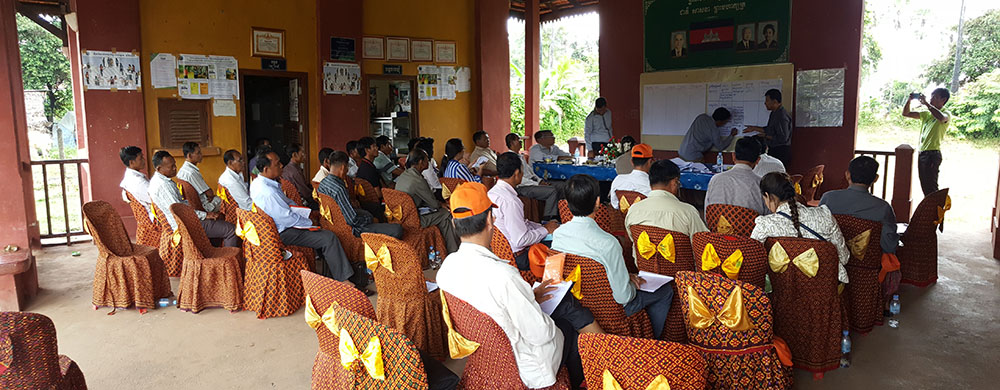
The Master program in Climate Change is preparing the strategic plan of research topics with high priority which supports the policy development as well as program implementation within Cambodia. The program is also seeking collaborative research projects with various agencies and academic institutions in the region.
Contact Details
Address
N/A
Phone
N/A
N/A