Introduction
RUPP has been a bastion of Cambodian intellectual training and talent cultivation for the past thirty-two years since it's reopening in 1980. Particularly, it has significantly contributed to the building of human and institutional capital, and practical knowledge in Cambodia's development. While the country is playing an increasingly important role in the regional and global economics, political and cultural dynamics, the past thirty-two years of international into the international political, capital and cultural flows have brought about challenges and opportunities specific to Cambodia but highly relevant in various ways to countries in both the region and of the world.

This Cambodian development experience – of negotiating cultural (knowledge) exchange and identity, confronting the (new) order of international capitalism, western ideologies and dominant knowledge, and engaging in various forms of regionalism, and internationalism – and the Cambodian development perspectives of the increasingly connected world remain inadequately understood and under-theorized. Knowledge production on Cambodia in the globalizing world remains undertaken largely by non-Cambodians, and there remain few locally based institutions engaging in studying Cambodia and its regional dynamics. Therefore, it is high time that RUPP, in the name of Cambodia, established and indigenous knowledge application and production base for furthering the country's development and promotion to the world.
Visions
IISPP is to become a leading institution and a center of excellence contributing to academic scholarship and research on Cambodia, Asia, the world and their interfaces.
Mission
Serve as a platform and hub (for Cambodian foreign scholars and researchers) for investigating critical issues confronting Cambodia, the region and the world;
Cultivate and further nurture emerging Cambodian scholarship and leadership;
Equip students with in-depth knowledge in disciplines of politics, public policy, economics, international relations, governance, and area studies;
Develop and nourish student's critical and analytical thinking skills, independent learning, and other transferable skills needed for a variety of real-world employment experiences;
Nurture student's ability to attain a higher cognitive order in their respective field of studies; and
Produce graduates with high attributes in leadership, skills and knowledge.
Goal
Become Cambodia's prominent academic sources of rigorous curricular programs, high-quality teaching, outstanding human capital development, and top-notch academic research in International Relations, Economics, Political Science, and Public Policy;
Advance and lead impactful Cambodia's research, knowledge production, and training on Southeast Asian affairs, Cambodian studies, and the 21st Century Maritime Silk Road; and
Provide premier knowledge dissemination for benefits of Cambodia, Asia, and the world.
Strategic Activities
the iispp’s strategic activities (degrees and functions offered)
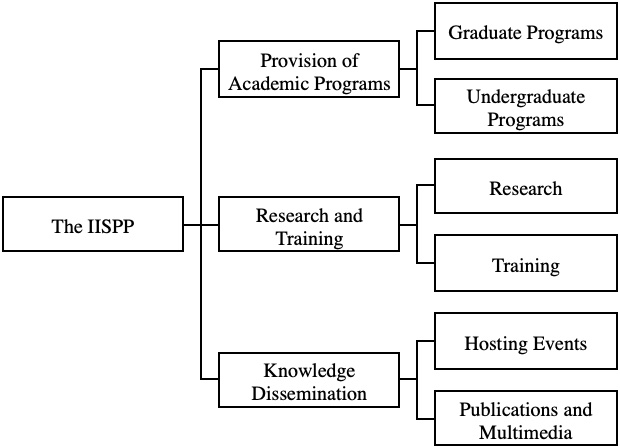
Institute for International Studies and Public Policy has three main strategic activities that correspond to degree programs provided by its departments and to functions of its centres. Per Diagram 1 below, the main strategic activities embraced by the institute are:1. Provision of Academic Programs, 2. Research and Training, and 3. Knowledge Dissemination.
Diagram 1: THE IISPP’s Strategic Activities
1. PROVISION OF ACADEMIC PROGRAMS
Institute for International Studies and Public Policy aims to provide both graduate and undergraduate programs in the fields of International Relations/Affairs, Economics. and Political Science/Public Policy. Its graduate and undergraduate programs are as follows:
Graduate Programs: Master of Science in Public Policy (MSc-PP.), Master of Science in International Affairs (MSc-IA.), and Master of Science in International Political Economy (MSc-IPE)
Undergraduate Programs: Bachelor of Arts in International Relations (BA-IR), Bachelor of Science in Economics (BSc-Eco) (with concentrations on international economics, digital economy, managerial economics, and actuarial economics), Bachelor of Arts in Politics and Public Administration (BA-PPA)
2. RESEARCH AND TRAINING
2.1 Research:
The research at IISPP is focused on both local, regional and global issues, and to be multidisciplinary in orientation by drawing on the social sciences and humanities, including anthropology, sociology, political science, public policy, linguistics, and human geography. Given Cambodia's strategic location, the institute positions specific area focuses and the ensuing connectivity (Refer to table 1 for Area Focuses). Crosscutting these constructed boundaries are contemporary issues confronting Cambodia and the region other societies. These issues are, thus, categorized into thematic clusters (Refer to table 1 for Thematic Clusters).
Table 1: Research's Area Focuses and Thematic Clusters
Research Function | Area Focuses | Thematic Cluster |
|
|
2.2. Training
The IISPP aims to provide the following quality training to policymakers, public servants, relevant non-state actors, researchers, and/or foreigners:
Research capacity training
Professional Connectivity training
Master class (Cambodian and Vietnamese Studies)
Khmer-for-foreigners
Southeast Asian languages
3. KNOWLEDGE DISSEMINATION
The IISPP undertakes knowledge dissemination through two methods: 1) hosting regular conferences, seminars, lectures, and policy dialogues, 2) and publication and media services. Table 2 below shows events, public aims to establish to disseminate knowledge.
Table 2: Knowledge Dissemination
Knowledge Dissemination | Hosting Events | Publication and Multimedia |
|
|
Careers
Prospective Careers
With its degree programs in International Relations/International Affairs, Economics (International, Digital, Managerial, Actuarial, and Political Economy), and Politics and Public Policy, the IISPP aims to provide a versatile base of high-quality knowledge and transferable skills that its graduates can utilize to pursue their careers in a broad range of public, private, and non-governmental sectors.
For Bachelor of Arts in International Relations (BA-IR) and Master of Science in International Affairs (MSc-IA.), the IISPP envisions its graduates’ employment at public institutions, UN agencies, development agencies, universities, embassies, international relations divisions, local and international NGOs, multinational corporations, and think-tanks. They can be foreign affairs officers in different sectors of their interests, diplomats, socio- and economic development officers, public relations and political affairs officers, foreign affairs analysts, specialists, and lobbyists, non-profit program coordinators, researchers, university lecturers, and peace, conflict, and humanitarian work specialists,
For Bachelor of Science in Economics (BSc-Eco) (International, Digital, Managerial, and Actuarial) and Master of Science in International Political Economy (MSc-IPE), the graduate will be competent to work at public, private, and non-governmental institutions as economic officers, economic research specialists, economic development offers and specialists, trade officers, market and financial analysts and consultants, risk assessment officers, actuarial analyst, data and statistical analysts, fintech and business consultants, university lecturers, and economics and financial forecasters.
With a Bachelor of Arts in Politics and Public Administration (BA-PPA) and Master of Science in Public Policy (MSc-PP.), IISPP’s graduates can pursue their careers as political affairs officers and specialists, policy officers and specialists, government liaison officers, political and social entrepreneurs, policy advisors and lobbyists, program officers, university lecturers, administration and coordination officers, and political and policy researchers.
Aside from these, IISPP’s research and training functions also aim to contribute to its areas’ scholarship and knowledge production, deliver well-balanced and highly credible research-based insights and recommendations, and serve as a supplement to the intellectual and professional development of policymakers, public servants, foreigners, and different stakeholders in their intellectual and professional pursuits.
Key Approaches to delivery
As indicated earlier, the Institute for International Studies and Public Policy focuses on teaching, research, and knowledge dissemination. For its degree programs, both postgraduate and undergraduate programs feature, on a macro-level, teaching and academic research and, on micro-level, interactive lectures, seminars, workshops, case studies, simulations, internships, and/or field visits.
For its research function, the IISPP will conduct research to be initiated or coordinated by the institution or host research projects that are conducted by visiting researchers. Sole research projects will be conducted by the IISPP’s full-time, affiliated, or visiting researchers, while collaborative research will be a joint effort between the IISPP’s researcher and external experts. In term of the IISPP’s training function, it involves short-term teaching of specific areas of knowledge and skills.
Besides, for knowledge dissemination, key approaches of delivery are through written and spoken communication and via physical and virtual events, the publication (Hard copies and soft copies), and multimedia (By means of audio and visual).
Composition of units
To arrive at its vision and goals, the Institute for International Studies and Public Policy embrace three research centers and three academic departments, and incorporates the IISPP’s strategic activities (provision of academic programs, research and training, and/or knowledge dissemination) into missions of its centers and departments. Per Diagram 2 below, RUPP’s IISPP features: 1. Center for Southeast Asian Studies, 2. Center for Cambodian Studies, 3. Cambodia’s 21st Century Maritime Silk Road Research Center, 4. Department of International Relations, 5. Department of International Economics, and 6. Department of Political Science and Public Policy. Center for Southeast Asian Studies, Center for Cambodian Studies, and Cambodia’s 21st Century Maritime Silk Road Research Center incorporate IISPP’s strategic activities on research, training, and knowledge dissemination. In the meanwhile, the Department of International Relations, Department of International Economics, and Department of Political Science and Public Policy incorporate IISPP’s strategy activity on the provision of academic programs (Teaching and academic research). Refer to Diagram 1 for an organizational structure of the Institute for International Studies and Public Policy.
Diagram 1: Organizational Structure

Center for Southeast Asian Studies (CSEAS)
Southeast Asia is the home to the world’s most dynamic and fastest growing regions and the center of complex histories, vast inter-state and intra-state diversities, and deeply rooted multidimensional challenges. As such, the Center for Southeast Asian Studies (CSEAS) aims to be a highly reliable and advanced hub of knowledge on Southeast Asian affairs to catalyze progress and advance prospects of positive integration, peace, and development. With its pool of high-caliber researchers, IISPP’s CSEAS aims to be an alternative to ad-hoc research, training, and policy dialogue arrangements with limited or short-lived national and regional impacts.
IISPP’s CSEAS embraces five main functions: research and capacity building, foreign language studies, policy dialogues, ASEAN knowledge hub, and outreach and networking. To put into perspective, the center aims to foster advanced, original, and rigorous research on complex topics and issues of high relevance to Southeast Asia, enhance knowledge production, and generate and disseminate research-based publications (CSEAS Book, the CSEAS Insight, the Cambodian Explorer, and CSEAS Policy Brief), which will be an alternative to many existing publications that tend to be largely empirical and descriptive in their accounts of topics. The center also intends to covert its well-refined theoretical, methodological, and empirical engagement into well-balanced and highly credible research-based insights and policy recommendations. In this connection, CSEAS’s research programs tend to be comprehensive and will be centered on 1. ASEAN Focus, 2. Regional Economic Studies, 3. Security, Political and Strategic Studies, 4. Socio-cultural Studies, 5. Country Studies Program, and 6. Vietnamese Studies. In line with this, to maximize impacts, the center also aims to provide research capacity training, professional connectivity training, and foreign language training to policymakers, public servants, researchers, and relevant stakeholders.
As an apolitical research center and think-tank, the Center for Southeast Asian Studies at the Royal University of Phnom Penh also strives to enhance face-to-face and/or virtual research and policy dialogues by developing a pool of experts in Cambodia and in the Southeast Asian region to discuss and share their expertise to the public through workshops, lectures and seminars, conferences, booth camps, research expos and policy dialogues with Track I officials. IISPP’s CSEAS also aims to cultivate a research society through hosting, among others, research exchanges, fellowships, and internships; promoting research studies and mobility; and attracting, as far as, young research enthusiasts on Southeast Asian affairs to engage in research culture.
Center for Cambodian Studies (CCS)
To bridge knowledge gaps in Cambodia, especially concerning its experiences and perspectives, the Center for Cambodia Studies (CCS) aims to provide a platform for investigating both historical and contemporary dimensions of issues confronting Cambodia and also to become a breeding ground for theoretical/conceptual innovations to better understand the country and countries as such. The center focuses on three strategic activities: conducting and hosting research, providing training, and coordinating knowledge production and dissemination with local and international partners.
In this relation, IISPP’s CCS will conduct its research, coordinate collaborative work, and host independently funded local and international researchers. Its research is focused on both local and transnational issues and aims to be multidisciplinary in orientation by drawing on the social sciences and humanities, including anthropology, sociology, economics, political science, linguistics, geography, and history. As such, this center’s main research programs will cover 1. Political, security, and economic interfaces and transformations, 2. Development strategies, migration, urbanization, and intra and cross-border trades, and 3. Public policy experiences, identity, and socio-cultural developments. On top of this, IISPP’s CCS will also provide Khmer-for-Foreigners Classes at all levels, Master Classes on specialized topics to be taught by experts, and Summer School on a more introductory level for those interested in some knowledge expansion and skill improvement. IISPP’s CCS will also undertake knowledge dissemination through monthly seminars and working papers based on the center’s research activities.
Cambodia 21st Century Maritime Silk Road Research Center (CMSRRC)
Against the backdrops of evolving international system and power structure and of China’s Belt and Road Initiative’s large socio-economic transformation potential, Cambodia’s 21st Century Maritime Silk Road Research Centre (CMSRRC) is established to timely interpret, inform, and influence developments and policy-making for the benefits and interests of Cambodia in all areas of the 21st Century Maritime Silk Road. IISPP’s CMSRRC has objectives to promote intensive learning about the 21st Century Maritime Silk Road, provide training courses for connectivity professionals, and advance exchanges of views on China’s “neighborhood diplomacy.” This center embraces three main functions in teaching and research, training and workshop, and publications and dissemination.
In its first strategic function of teaching and research, CMSRRC conducts rigorous policy research activities and projects under its three broad themes of political and strategic program, economic and financial program, and socio, cultural and environmental program. The center also offers public lectures and short intensive certificate courses to students and the public on China and the Belt and Road Initiative, particularly the 21st Century Maritime Silk Road. In its second function, CMSRRC partners with research think tanks from China and the Southeast Asian region to provide training courses to connectivity professionals including policymakers, civil servants, and researchers on diplomatic, business, economic and cultural approaches to the 21st Century Maritime Silk Road. The center also organizes periodic forums, and conferences. and regional symposiums and engages in policy dialogues, interviews, and commentaries. In its third function of publications and dissemination, CMSRRC publishes and disseminates its research products including books, policy briefs, articles and chapters, symposium proceedings, and videos to, among others, public institutions, think-tanks, associations, private sector, and education institutions.
Department of International Relations (DIR)
In view of the fact that Cambodia has experienced fast-paced development and become increasingly integrated into regional and global systems and that Cambodia has, however, remained in need of broader perspectives and rational worldviews, IISPP’s DIR, a descendent of the Department of International Studies, aims to produce a pool of high quality and intellectually matured graduates with expertise in International Relations. It embraces its primary missions in teaching and research, engagement and services, and international cooperation and integration.
Under the rubrics of its four core values of excellence, integrity, professionalism, and selfless services, IISPP’s DIR offers its undergraduate and graduate students a distinctive B.A in International Relations (BA-IR) and a Master of Science in International Affairs (MSc.IA). Its programs embrace interdisciplinary coherence and are divided into thematic clusters of, among others, Global Governance Studies, Regional and Area Studies, International Law and Organizations, and Conflict Resolutions and Security Studies. From its rigorous and intensive degree programs, IISPP’s DIR intends to equip its students with highly relevant theoretical and practical knowledge, research skills, critical thinking and analytical skills, and transferable skills necessary for their successful careers in international affairs and the relevant.
Department of International Economics (D.I.Eco)
In response to the rapidly changing, fast-paced, and the hypercompetitive world of economic interdependence, complexities, and crises and in line with Cambodia’s aspirations to use economic diplomacy and to become an upper-middle-income country, IISPP’s Department of International Economics (D.I.Eco) is envisioned to equip its students with highly relevant competences and necessary adaption and innovation skills for their careers in economics. IISPP’s D.I.Eco, thus, offers a Bachelor of Science in Economics (BSc-Eco) with four concentrations in 1. International Economics, 2. Digital Economics, 3. Managerial Economics, 4. Actuarial Economics and Master of Science in International Political Economy (MSc-IPE).
To underline, DIE’s undergraduate program in Economics will enrich its students with a baseline of theoretical, empirical, and analytical tools, economic models, quantitative and qualitative techniques, and rational problem-solving skills. Students will also be introduced to the growing challenges of, among others, markets, trade, banking, and financial systems, and monetary integration. Based on students’ chosen specialization, IISPP’s D.I.Eco will equip students with knowledge and understanding of, among others, economic interactions between/among countries/institutions; non-traditional, digital connections and economic strategies/outputs; rational managerial decision-making in the face of challenges, obstacles, and scarce resources; and most plausible analyses and assessment of risks and uncertainty to develop best possible strategies to minimize the related costs or consequences. In its more advanced program of MSc-IPE, IISPP’s D.I.Eco will equip its students with advanced theoretical, analytical, and research tools and expose its students to the interaction between economics and politics and their influences on one another.
Department of Political Science and Public Policy (DPSPP)
To produce Cambodia’s well-rounded and skillful graduates with in-depth knowledge in politics and public policy for the country’s strong, well-responding, and robust system, IISPP’s Department of Political Science and Public Policy (DPSPP) offers rigorous, multi-disciplinary programs in political science and public policy. IISPP’s DPSPP offers a Bachelor of Arts in Politics and Public Administration (BA-PPA) and Master of Science in Public Policy (MSc-PP) and incorporates in its programs a holistic and integrative spirit of liberal thinking through a series of interactive lectures, seminars, workshops, case studies, and simulations.
IISPP’s DPSPP intends to equip its students with theoretical, conceptual, substantive, and methodological lenses in political science and public policy. The program will enable its students to study complex beings of state, nation, government, and their institutions, processes, ideologies, policies, and behaviors. The program will also deepen the knowledge and understanding of its students of cross-cutting themes including conflicts and transnational politics and equip them with critical skills and social scientific literacy for them to succeed in their careers. Likewise, the study of public policy at IISPP’s DPSPP will enable students to understand the nature and roles of policy, policy design, and policy process and development. While exposing its students to challenges faced by states and their people, DPSPP will also enrich them with well-rounded perspectives on policy issues and a versatile base of knowledge and skills to comprehend, interpret, analyze, and/or develop policy solutions for challenges facing society.
Department of Vietnamese Studies (D.V.N.S)
Beginning from the Đổi Mới economic reform in the late 1980s, Vietnam has steadily grown both economically and culturally and transformed significantly to become an important key player in the region. In the context of bilateral relationship, Vietnam’s proximity to and long border sharing with Cambodia heightens its importance and implications for Cambodian foreign policy and development. Despite Vietnam’s growing importance and influence in the region and the intertwined relationship, a well-organized study of Vietnam has remained neglected among students, scholars, and researchers in Cambodia. Therefore, the founding of the Department of Vietnamese Studies at the Royal University of Phnom Penh (RUPP) aims at bridging this academic gap by enabling students, scholars, researchers, policymakers and practitioners, and the general public in Cambodia to maximize instrumental benefits from socio-cultural, political and economic interfaces with high-quality knowledge in Vietnamese language, history, economics, politics, and culture. Therefore, D.V.N.S offers a Bachelor of Arts in Vietnamese Studies, Vietnamese Translation and Interpretation, Vietnamese Business Communication, and a Pre-Departure Vietnamese Language Program to Cambodian students.
Partners
The IISPP aims to build partnerships with academic and non-academic institutions locally and internationally. The following list includes potential partners for which the IISPP can engage with in various capacities:
Royal School of Administration (Cambodia)
Asian Vision Institute (Cambodia)
The Center for Khmer Studies (Cambodia)
Cambodia Development Center CD-Center (Cambodia)
ISEAS – Yusof Ishak Institute (Singapore)
Royal Academy of Cambodia (Cambodia)
University of Social Science and Humanities HCM (Vietnam)
Cambodia Development Resource Institute (Cambodia)
Center for Southeast Asian Studies, Kyoto University (Japan)
Institute of Diplomacy and International Studies at Rangist University (Thailand)
International Institute for Asian Studies (The Netherlands)
National University of Vietnam HCM (Vietnam)
And others
Graduate Programs
MASTER OF SCIENCE IN INTERNATIONAL AFFAIRS (MSc-IA)
OVERVIEW
Institute for International Studies and Public Policy of the Royal University of Phnom Penh provides a two-year, research-focused full-time Master of Science in International Affairs (MSc-IA) program with the aim of developing deep knowledge and practical skills in international affairs and offering quality education in this field of study. This program has a rigorous, hands-on, and interdisciplinary curriculum of social science, combined with a wide range of science courses instrumental to the study of international affairs.
The program includes four core science courses of advanced Research Methods (I&II), Data Analytics for Policy Analysts, and Game Theory for Strategic Decision Making. Other core courses of social science include International Political Economics, Advanced International Relations (Theory and Practice), International Law and Organizations, Foreign Policy Analysis, Special Seminars (Geopolitics-focused), and Ethics and Leadership for Policy Makers. Besides, the program offers at least two specialised elective courses crucial to international affairs. This combined curriculum also integrates extensive experiential learning such as Master Thesis or Capstone Project with national and international organizations.
PROGRAM LEARNING OUTCOMES
Upon successful completion of this graduate program, students are able to:
COGNITIVE SKILLS
Demonstrate their in-depth and critical knowledge of political, security, and economic factors, facts, concepts, and generalizations that inform intra-state and cross-border relations among state and non-state actors.
Possess knowledge of the latest developments in international affairs.
COGNITIVE SKILLS
Evaluate perspective, quality, and accuracy of information sources with reference to international relations, international economy, security and other related fields.
Utilize deep and critical knowledge of diverse worldviews, experiences, power structures, different effects of human organizations and actions on the global system to develop informed actions to address global and regional problems.
INTERPERSONAL SKILLS AND RESPONSIBILITY
Execute tasks in an academic setting which require interpersonal skills, leadership skills, and independent learning skills useful and necessary for employment and career development in public and private institutions and organizations.
Demonstrate an understanding of philosophical and social contexts and respect for ethics and ethical standards of the discipline when creating tools to address local, regional, and global social, political, economic, and environmental challenges.
Develop a sense of appreciation and respect for national interests, culture and cultural diversity.
COMMUNICATION, INFORMATION TECHNOLOGY, AND NUMERICAL SKILLS
Demonstrate an ability to effectively communicate information and ideas in English in both local and international contexts.
Utilize the most appropriate information technology, statistical, and mathematical techniques and tools in gathering, analyzing, interpreting, and presenting information.
Program Duration
The MSc-IA program requires two years of full-time study. Each academic year is scheduled into two semesters per year. Students are required to take four core courses in the first two semesters of their first year, and study two core courses in the third semester and two elective courses in the fourth semester of their second year. Students are expected to complete their final project, thesis or capstone, and obtain a minimum of 48 credits by the end of the last semester for the degree.
ADMISSION REQUIREMENTS
Applicants must fulfil the following requirements for enrolment in the program:
Bachelor’s degree or equivalent
Supporting documents (e.g., Bachelor's certificate verified by the Accreditation Committee of Cambodia (ACC), academic transcription, and a copy of Bachelor's thesis if any)
English proficiency
Minimum IELTS 6, TOEFL iBT 70, or passing the IISPP English Proficiency Test
A statement of purpose
A good statement of purpose should include these elements:
Personal background
Current and previous academic details
Professional experience (full/part time, voluntary, or others)
Short and long-term goals during and after your study
Reasons why you wish to study at IISPP
Reasons of being interested in the Master of Science in International Affairs program
About extra-curricular activities
Published works if any (single/co-authored article, title, publisher, date, etc.)
Interests and hobbies
A letter of recommendation
From the previous course instructor or the current or previous employer
CREDIT REQUIREMENTS
Students are required to obtain a minimum of 48 credits for the successful completion of the program.
Modules (a minimum of 36 credits)
10 core modules (30 credits)
2 elective modules (a minimum of 6 credits)
Master thesis or capstone (12 credits)
Proposal defence (3 credits)
Dissertation and oral defence (9 credits)
CURRICULUM STRUCTURE
Year1 | ||||
Semester | Module | Code | Course Title | credit |
I
| Core | MIA501 | Advanced International Relations: Theory and Practice | 3 |
Core | MIA502 | International Political Economy | 3 | |
Core | MIA503 | Foreign Policy: Concept, Issues, and Analysis | 3 | |
Core | MIA504 | Quantitative Research Methods(I) | 3 | |
II
| Core | MIA505 | International Law and Organizations | 3 |
Core | MIA506 | Game Theory and Strategic Decision Making | 3 | |
Core | MIA507 | Special Seminars (Geopolitics focused) | 3 | |
Core | MIA508 | Quantitative Research Methods (II) | 3 | |
Year2 | ||||
III | Core | MIA509 | Data Analytics for Policy Analysts | 3 |
Core | MIA510 | Ethics and Leadership for Policy Makers | 3 | |
IV
|
Elective | MIA601 | Non-Western International Relations Theory |
6 |
MIA602 | Green Transformation and Policy in Asia | |||
MIA603 | Evolution of the Global Order | |||
MIA604 | ASEAN and Regionalism in Southeast Asia | |||
MIA605 | Diplomacy of Small States in a Changing World | |||
MIA606 | US-China Relations and Great Power Politics | |||
MIA607 | Chinese Political Leadership and Economic Development | |||
MIA608 | Cyber Security: Concept, Theory, and Practice | |||
MIA609 | Development, Innovation, and Technology Policy | |||
MIA610 | Media, Public Opinion, and Public Policy | |||
III-IV | Master Theis or Capstone | 12 | ||
Total | 48 | |||
APPLICATION PROCESS
Online application, or at the IISPP Center of the RUPP
Review of application by the IISPP Admission Committee
Sending of unconditional or conditional offer to the applicants
Enrolment in the graduate program at IISPP
(Note: Applicants can download the application form and submit to lak.chansok@rupp.edu.kh)
Contact Info
For further information and guidance, contact us:
- Email: lak.chansok@rupp.edu.kh | vrak.thanit@rupp.edu.kh
- Phone: (+855)92 228 827 | (+855)16 532 089
- Address: IISPP’s Graduate Programs, Room E3.21, Building E of the RUPP
- Please scan the QR codes below:
IISPP MSC-IA GROUP | IISPP MSC-IA CHANNEL
IISPP MSC-IA GROUP | | IISPP MSC-IA CHANNEL |
 |  |
Contact Details
Posts

All Departments

Department of International Relations (DIR)

Department of International Economics (DEco)

Department of Political Science and Public Policy (DPSPP)

Department of Vietnamese Studies (D.V.N.S)

Center for Southeast Asian Studies

Cambodia 21st Century Maritime Silk Road Research Center
